Washington's Revolution by Robert Middlekauff
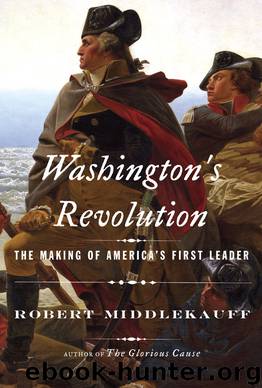
Author:Robert Middlekauff [Middlekauff, Robert]
Language: eng
Format: epub
ISBN: 978-1-101-87424-0
Publisher: Knopf Doubleday Publishing Group
Published: 2015-02-02T16:00:00+00:00
The decision to go into winter quarters was kept from the British and from the American army itself until just before the actual move from Whitemarsh, later in December. The British, of course, received no formal notification, and the army was informed only after it was put on the road to Valley Forge. Weeks before Washington wrote Laurens of his intentions, the Congress, accepting the necessity of winter quarters, had discussed what the army should do after Germantown. A few delegates, apparently immune to facts when thinking of the war, urged that an attempt be made to destroy Howe and take Philadelphia. The simplicity of these suggestions did not trouble their makers, but they did trouble Washington, who had to explain that reality could not be made to conform to such wishes. Most members of Congress, however, required no explanation that the condition of the army made going into winter quarters unavoidable. A committee from Congress visited the camp at Whitemarsh early in December and spent its days there in a serious probe. The condition of the troops was a sobering surprise, and Washington drove home to them the lesson of a poverty-stricken army. The chief lesson was familiar, and for some tiresome: He had close to three thousand men in need of shoes, and almost everyone in camp was hungry.21
Where the army should go for the winter was another matter, and once the idea sank in that the army was going to settle in, Washington began hearing from members of Congress as well as others, in particular members of the legislatures of Pennsylvania and New Jersey.
In Pennsylvania, there were many men who thought that Washington should use the winter to recapture Philadelphia; others advocated spreading the army around in cantonments in order to give protection across the state. No planning for such a dispersal proceeded very far, but there was a feeling in the Pennsylvania legislature that if an attack on Philadelphia was impossible, the army should not be allowed to do anything that would deprive inland towns and hamlets of its protection.
The move from Whitemarsh to Valley Forge took six days, owing to the physical condition of troops, horses, and wagons. The soldiers marched, some on bloody feet. Many horses were sick or weakened by the thin supply of forage, and wagons to carry supplies were also scarce.22
Valley Forge, about eighteen miles northwest of Philadelphia, had been chosen because it was close enough to permit the army to move effectively in response to British forays into the countryside. It was also far enough away from Philadelphia to prevent a British force there from surprising an army in camp. No barracks stood ready in Valley Forge, but the surrounding hills were covered with trees, many large enough to be cut down and turned into lumber for housing. Washington issued orders to cut down the trees and gave the specifications for huts that would provide shelter from snow and low temperatures. Officers organized their soldiers into work parties, and by early January most of the men had roofs over their heads.
Download
This site does not store any files on its server. We only index and link to content provided by other sites. Please contact the content providers to delete copyright contents if any and email us, we'll remove relevant links or contents immediately.
Waking Up in Heaven: A True Story of Brokenness, Heaven, and Life Again by McVea Crystal & Tresniowski Alex(37924)
Still Foolin’ ’Em by Billy Crystal(36462)
Cecilia; Or, Memoirs of an Heiress — Volume 1 by Fanny Burney(32716)
Cecilia; Or, Memoirs of an Heiress — Volume 2 by Fanny Burney(32083)
Cecilia; Or, Memoirs of an Heiress — Volume 3 by Fanny Burney(32063)
Fanny Burney by Claire Harman(26719)
Empire of the Sikhs by Patwant Singh(23199)
We're Going to Need More Wine by Gabrielle Union(19167)
Hans Sturm: A Soldier's Odyssey on the Eastern Front by Gordon Williamson(18722)
Plagued by Fire by Paul Hendrickson(17534)
Out of India by Michael Foss(17021)
All the Missing Girls by Megan Miranda(16683)
Cat's cradle by Kurt Vonnegut(15549)
For the Love of Europe by Rick Steves(14891)
Pimp by Iceberg Slim(14785)
Molly's Game by Molly Bloom(14254)
Bombshells: Glamour Girls of a Lifetime by Sullivan Steve(14215)
Leonardo da Vinci by Walter Isaacson(13505)
4 3 2 1: A Novel by Paul Auster(12609)
